Case Study-1 : Provincial Labour & Student Support Framework (Canada, 2019)
Overview:
In 2019, Metvision’s founder developed an independent economic framework designed to strengthen regional economies by optimizing domestic human capital, reducing reliance on external labour pipelines, and improving youth employment outcomes.
The Challenge:
The Province of Saskatchewan, Canada faced structural difficulties in balancing labour demand—particularly within NOC 1311 (Accounting Technicians and Bookkeepers)—while local students required stronger financial and career‑development support. Despite having an available student population, the province continued to depend on foreign recruitment to fill technical roles.
Metvision’s Strategy:
Metvision proposed a dual‑action economic model that combined mathematical forecasting with localized IT solutions to:
- Build a self‑sustaining financial support ecosystem for local students
- Fast‑track domestic talent into vacant technical roles
- Served as a successful baseline test for Metvision’s economic theories
- Provided foundational insights for future AI‑driven labour strategies
Government Response:
The Government of Saskatchewan, Canada appreciated and issued an official acknowledgment confirming that the proposal was a thoughtful perspective.
Evolution :
The core principles of this 2019 framework—balancing labour supply and demand using advanced technology—have since evolved into Metvision’s current AI‑based macroeconomic strategies for India’s economic growth.
CASE STUDY-2 : TECHNOLOGY ENABLED PROTECTION FOR REMOTE INDIGENOUS COMMUNITIES (AUSTRALIA, 2020)
(Australian Government – Two‑Page Official Acknowledgment, 2020)**
Background & Public Health Challenge
During the early phase of the COVID‑19 pandemic, remote Indigenous communities in Australia faced heightened vulnerability due to limited healthcare access, geographical isolation, and increased risk of severe outcomes. Ensuring timely medical support without exposing communities to infection became a critical national priority.
Recognizing this gap, Gurtej Singh proposed a technology‑driven safety strategy aimed at strengthening remote healthcare delivery, reducing exposure, and enabling rapid medical response through digital tools.
Strategic Proposal Submitted
The proposal recommended the deployment of:
- Remote communication systems
- Telehealth‑based medical consultations
- Technology‑enabled early detection and triage
- Reduced physical contact for frontline workers
- Digital support for self‑isolation and quarantine
The objective was to protect Indigenous communities by leveraging technology to maintain continuity of care while minimizing infection risk.
Government Response (Two‑Page Official Letter)
The Australian Government issued a two‑page formal acknowledgment, combining responses from:
Office of the Minister for Indigenous Australians (Hon. Ken Wyatt AM MP)
The Minister’s office confirmed:
- Receipt and review of the proposal
- Alignment with the national COVID‑19 Emergency Response Plan
- Recognition that Indigenous Australians were a priority group
- Relevance of the proposal to the nationwide expansion of telehealth services
COVID‑19 Coordination Group, National Indigenous Australians Agency (NIAA)
The continuation page, signed by the Group Manager, further stated:
- Appreciation for the concern shown for Indigenous communities
- Acknowledgment of the proposal’s value
- Recommendation to share the proposal with the Department of Health, the lead agency for pandemic response
Together, the two pages form a complete, continuous government communication demonstrating multi‑level engagement.
Outcome & Significance
The two‑page acknowledgment confirms that the proposal:
- Was reviewed at both ministerial and federal coordination levels
- Was considered relevant to national pandemic planning
- Aligned with Australia’s telehealth expansion strategy
- Was directed to the appropriate lead authority for further evaluation
This establishes a clear record of government‑level recognition for a technology‑based public health intervention.
Impact & Contribution to Public Policy Dialogue
This case study highlights how citizen‑driven technological insights can contribute meaningfully to national emergency planning. It also demonstrates the Australian Government’s openness to innovative ideas aimed at protecting vulnerable populations during a global crisis.
The acknowledgment strengthens the global portfolio of Gurtej Singh also by showcasing:
- International engagement
- Cross‑departmental recognition
- Alignment with national health priorities
- Contribution to Indigenous community protection strategies
Case Study-3 :Saving Lives in Dharavi Crises with Rapid Government Engagement (INDIA, 2020)
Background & Public Health Challenge
In July 2020, Dharavi, Asia’s largest slum, became the epicenter of Mumbai’s COVID‑19 crisis. With extreme population density, limited healthcare access, and high fatality risk, urgent intervention was required. The Brihanmumbai Municipal Corporation (MCGM) needed a scalable strategy for doctors, hospitals, and containment to save millions of lives.
Strategic Proposal Submitted
Subject: Dharavi Crisis — Strategy to arrange doctors and hospitals in Mumbai and save millions of lives during the Corona pandemic
A comprehensive strategy was submitted to the Government of Maharashtra, outlining actionable steps for Dharavi containment, medical resource deployment and crisis management with technology.
Government Response — Official Email Chain Evidence
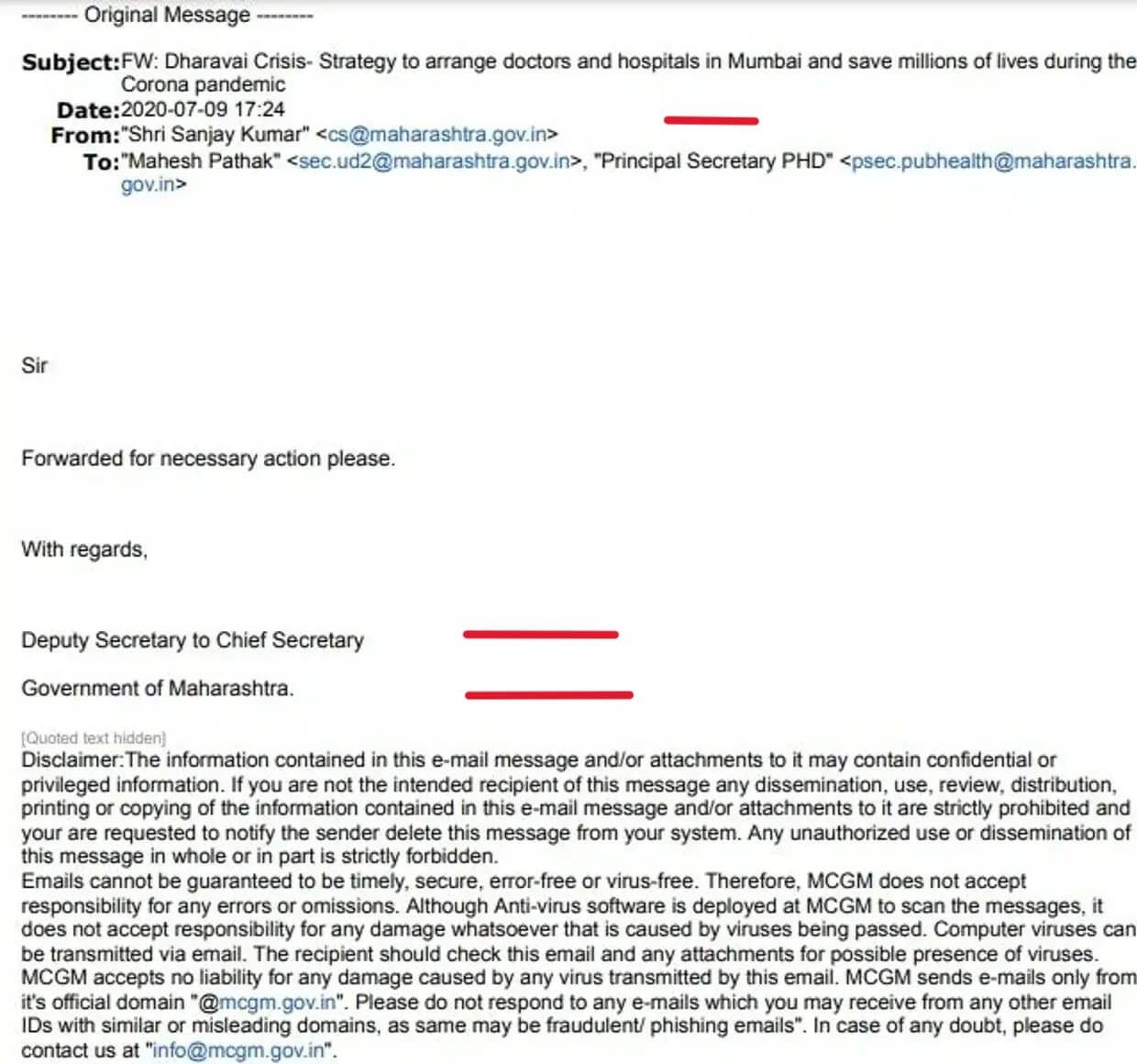
Email 1 — Chief Secretary Escalation
- Date: July 9, 2020, 5:24 PM
- From: Shri Sanjay Kumar, Chief Secretary, Maharashtra (cs@maharashtra.gov.in)
- To: Mahesh Pathak, Secretary UD‑2 + Principal Secretary Public Health
- Directive: “Forwarded for necessary action please.”
Email 2 — Municipal Commissioner Engagement
- Date: July 9, 2020, 6:31 PM
- From: Shri Iqbal Singh Chahal, Municipal Commissioner, MCGM (mc@mcgm.gov.in)
- Action: Commissioner reviewed the strategy.
- Confirmation (8:04 PM): Gurtej Singh Bhasin replied — “Thank you so much for considering the strategy related to Dharavi crisis and also for providing inner‑satisfaction to serve my Indian people.”
Outcome & Significance
This two‑email chain establishes:
- Chief Secretary level action — Highest bureaucratic authority in Maharashtra engaged.
- Cross‑department activation — Urban Development and Public Health Secretaries tasked.
- Municipal Commissioner review — Shri Iqbal Singh Chahal, who led Dharavi’s globally praised COVID response, personally considered the strategy.
- Official domain proof — maharashtra.gov.in + mcgm.gov.in confirm authenticity.
Impact & Contribution to Public Policy Dialogue
This case demonstrates:
- Domestic government validation at Chief Secretary and Commissioner level.
- Real‑time crisis engagement — Same‑day action during Dharavi’s worst phase.
- Top‑down activation of Maharashtra’s COVID machinery.
- Global portfolio completion — Saskatchewan, Australia, Canada, California, and now Maharashtra.
- Relevance to India 2026: The Dharavi crisis‑response model that reached Maharashtra’s Chief Secretary and Mumbai’s Commissioner is now scaled with AI to create jobs and increase the income of unorganized workers.
APPEAL TO AMBANI AND ADANI GROUPS
Both your esteemed groups have undertaken significant work in the redevelopment of Dharavi and Juhu Gali.
Alongside this transformation, we respectfully request you to also explore opportunities to create sustainable employment for the people of Dharavi and Juhu Gali—enabling them to participate with dignity in work and share in the benefits of India’s economic growth.
Thank you.
🌐 metvision-global.com
KIRAT | AI-Driven Employment and Economic Innovation



GOVERNMENT LETTERS
GLIMPSE OF GURTEJ SINGH'S EXPERTISE IN EDUCATION SECTOR


GLIMPSE OF GURTEJ SINGH'S EXPERTISE IN ECONOMICS SECTOR

GLIMPSE OF GURTEJ SINGH'S EXPERTISE IN TECHNOLOGY SECTOR

GLIMPSE OF MAHARASHTRA GOVERNMENT LETTERS RELATED TO GURTEJ SINGH AND DHARAVI CRISIS
.jpg/:/)
DSG Management Committee (Statutory body under DSG Act 1971, of the Government of India)

Respected Manjider Singh Sirsa Ji ( who signed the above appointment letter ) is now Honorable Minister of Industries, Delhi Government, India
GLIMPSE OF Gurtej Singh'S — AI BACKGROUND OF 24 Years

ROADMAP FOR THE IMPLEMENTATION OF THE KIRAT AI‑DRIVEN ECONOMIC MODEL AND RELATED CASE STUDIES
AI is an integral component of KIRAT, designed to analyse economic opportunities, identify employment potential, and support activities that can generate jobs and income growth.
These frameworks are proprietary intellectual products; therefore, we do not disclose their internal formulation or structural details at preliminary stages or on open platforms.
However, we are fully prepared to present the benefits, outcomes, and national‑level impact of our strategies directly to Respected and Honorable Presidents, Prime Ministers, Chief Ministers, or global leaders under appropriate confidentiality protocols.
We respectfully request and firmly believe that such discussions must take place exclusively at the highest institutional level to ensure clarity, confidentiality, and proper institutional evaluation of our work.
Thank you.
Metvision and Team
Disclaimer:
Metvision is an abbreviation representing Metro Enterprises and Technologies and its unique vision.
- This brand operates independently and maintains no affiliation, association, or partnership with any other companies, subsidiaries, or entities that may share similar names or branding.
- And above-mentioned, Metvision Global Strategy is an independent research initiative. Not affiliated with, endorsed by, or connected to Starlink, Airtel, Jio, BSNL, Amazon, Reliance JioMart, Tata Neu, Government of India, or Prime Minister’s Office. All company and government names are used for reference only. No partnership implied.
#####
Quick Links
Indian Ministry of External Affairs Letter
WEBSITE DEVELOPED BY : METRO ENTERPRISES